

“Kai, I need some new music,” confessed my mother. “I just keep listening to the same stuff all the time.”
Whether she meant it or not, this was an insinuation, and I took that as an indirect order to get straight to work.
Eager to please, I compiled a thirty track-long playlist to replace her presumably tasteful but monotonous song choices for her daily morning dog walk. A theme wasn’t really a priority, and the selection process was just simply “I know she likes that,” or, “I think she’ll like that.”
Familiar favourites like Billy Joel and Frankie Valli served as the hook, and allowed the introduction of more contemporary artists such as Wunderhorse and The Last Dinner Party. I threw in a bit of 80s synth-pop and a sprinkle of Bobby Womack and John Lennon, and it was done.
The playlist was a success, not least thanks to one song in particular.
“God, I love that Dubstar track, I haven’t heard it in forever! Is it a late 90s one?” She asked.
The song was “Stars”, and I pondered how many other people of a similar age to my mum (of which I’m unwilling to disclose) have felt that same sort of nostalgia whenever they’ve heard it.
Nostalgia often plays a huge role in music, not just in terms of commercial success of artists, but in their cultural influence, and the effect they can have on people’s day to day lives. When I spoke to Steve Hillier, one of the founding members of Dubstar, and asked for his thoughts on the importance of nostalgia in music, he agreed it has a big presence, and described it as “the undercurrent” in a lot of his writing:
“Nostalgia is powerful. It shapes the stories we write about ourselves, helps us make sense of chaos, and ties us to the people and places that formed us. You hear a song in a café you haven’t thought of since 1989 and suddenly you’re back there — the same feelings, the same faces. It feels good.”
So, with that in mind, what could be a more perfect fit for my mum’s woodland walks—accompanied only by two cockapoos for protection—than a time transporting, feeling inducing, indelible track like “Stars”?
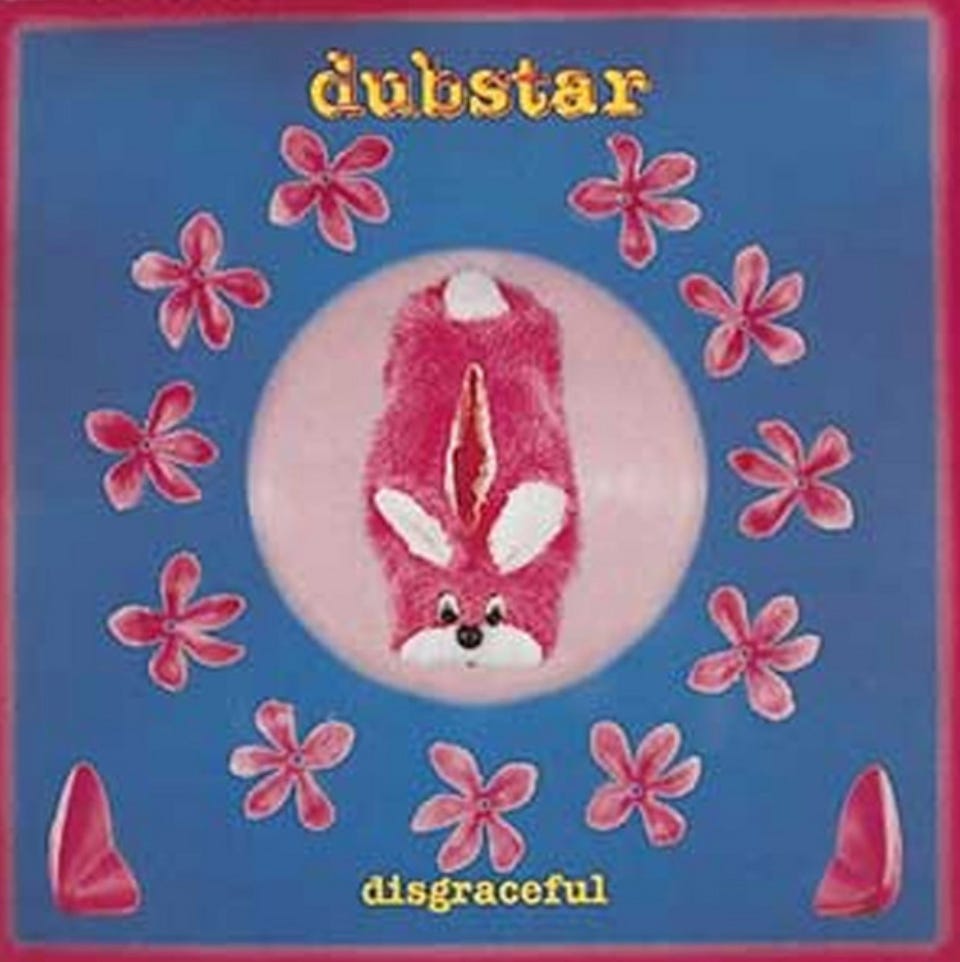
To answer her question, though—it’s a mid-90s one. ‘95 to be exact. Actually, it’s thirty years ago next month since the debut album, Disgraceful, was released.
Origins
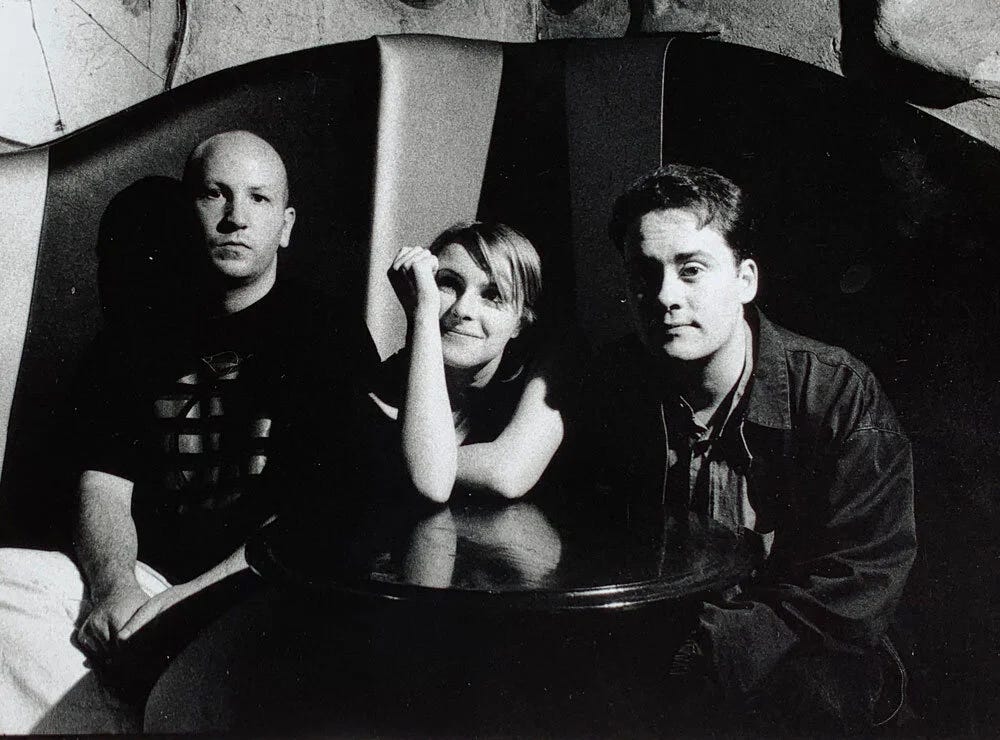
Formed in Newcastle in 1991 and originally named Perfect Tone Series, the band renamed themselves to The Joans early on, and were founded by singer-songwriter Steve Hillier and guitarist Chris Wilkie.
It wasn’t until 1993 when the Halifax-born Sarah Blackwood joined the band at the invitation of Hillier, who was struck by Blackwood’s vocals after her boyfriend left a cassette tape showcasing her voice lying around in Hillier’s flat, and by 1994, he had handed over vocal duties over to Blackwood entirely.
The band were invited to record at a studio in Darlington by owner Graeme Robinson, who had seen them perform a cover of Wakefield band Brick Supply’s “Not So Manic Now” at a gig in Newcastle. Robinson passed the recordings on to journalist Andy Ross, who was running a subdivision of iconic label EMI at the time, named Food Records. It was at that point that, at the request of Ross, the band ditched the name The Joans, and renamed themselves Dubstar.
In early 1995, Hillier, Wilkie and Blackwood were ready to record their debut album, and Andy Ross contacted his friend Stephen Hague, who had worked with Pet Shop Boys and New Order, to discuss co-producing with Graeme Robinson.
After recording at studios in London and Darlington, Disgraceful was released in October 1995, and the album produced four UK Top 40 singles in the form of magnum opus “Stars”, their cover of “Not So Manic Now”, as well as “Anywhere”, and “Elevator Song”.
The Disgraceful Years
The album’s opening track and muse for this edition of Echoes, “Stars” is indescribably quintessentially 1990s. It’s a shimmering, melancholic piece of music, and so much more ethereal compared to the Britpop bands that hogged the charts at the time.
Somewhat reminiscent of tracks from Saint Etienne’s 1991 album Foxbase Alpha, “Stars” blends a mixture of gentle guitar strums and electronic beats, creating an intimate and cosmic-like feel.
Lyrically, it’s open to interpretation, but the general consensus is that it focuses on a detached view of love and connection, not through bitterness, but through quiet acceptance.
“I’ve no problem with Dubstar being remembered mainly for Stars.”
- Steve Hillier speaking to Pop Valley
“Stars” is followed in the track listing by fellow Top 40 single, “Anywhere”. The two songs differ dramatically, both musically and stylistically, with the latter confining itself to being a declaration of love and service, as Blackwood angelically states “I don’t mind, ‘cause I’ll be around anywhere, any place you want me” over an upbeat melody.
“Elevator Song” is the fourth song on the album, and starts with a melody akin to a dance track plucked straight out of the Haçienda, but soon morphs into a reggae-ska-dub-style piece which more than does Dubstar’s name justice.
In January 1996, Dubstar made their debut appearance on BBC Top of the Pops, performing their other Top 40 single, “Not So Manic Now”—a dark, ambiguous tale of violence and female vulnerability smuggled under a pretty melody.
They made their second appearance just two months later, where they performed the soon to be re-released “Stars” in March 1996.
Disgraceful went on to sell over a million copies worldwide, and “Stars” was subject to a number of remixes, which were often played in the British nightclub scene.
Post-Disgraceful
After reshuffling their management and replacing Graeme Robinson with Stevo Pearce, Dubstar began work on their second album in late 1996, reuniting with Stephen Hague in New York.
Hillier was unsatisfied with the material, and returned to Newcastle to write some new songs.
In June 1997, Gary Numan released a compilation tribute album named Random, which featured covers from Saint Etienne, Matt Sharp and Damon Albarn, and Moloko. Dubstar contributed a cover of “Everyday I Die”.
Goodbye, Dubstar’s second album, was completed in the UK and released in September 1997, and whilst it didn’t dominate the charts, received positive feedback and carved out a loyal fan base.
“No More Talk”, “Cathedral Park”, and “I Will Be Your Girlfriend” each made the UK Top 40.
In 1998, personal tensions began to form cracks in the band members’ relationship. The trio managed to complete and release their third album, Make It Better, in June 2000, but soon disbanded a few months later after Hillier left due to internal disagreements. The band were subsequently dropped from Food Records.
Dubstar remained separated until 2009, before making recordings with the familiar Stephen Hague. They performed a few live shows, supporting Human League, as well as their own headline comeback gigs.
However, by 2014, Hillier had left the band again due to “personal and professional conflicts”—this time, for good.
“But, nostalgia can be dangerous. It isn’t memory, it’s emotion — useful in small doses, but never real. It’s your imagination giving you a little gift: yes, that was good. The real challenge is living in the present, because that’s all we truly have. And if you can get through middle age without dwelling on the past, you’ll be fine.”
- Steve Hillier speaking to Pop Valley
Where are they now?
Steve Hillier embarked on a solo career, releasing music under his own name, as well as under the name POLITEK.
Sarah Blackwood and Chris Wilkie still operate under the Dubstar name, and released two albums, One and Two, in 2018 and 2022, respectively.
The foundations laid by the initial trio are still there for all to hear in Dubstar’s most recent two records. The blend of intelligent, eloquent lyricism with Northern English, kitchen sink drama-esque phrases in “Love Gathers” from One is a prime example; “By the time it was done, you’d decimated my soul”…“disapproval en masse like an insidious gas” are just some of the enunciations from Sarah Blackwood, who goes on to say “and then you gave me the shove”.
Whilst I wouldn’t necessarily describe Dubstar as a “one hit wonder”, they are undoubtedly best known for “Stars”, and when I asked Steve if there was any resentment towards this, he told me he didn’t have a problem with it:
“Pop has always been driven by singles, and now more than ever albums are really for those who dig deeper. You can’t dictate how music is received, and trying to control that usually looks embarrassing. Most of our catalogue is still there for anyone curious enough to find it, but if we’re defined by Stars, I can think of far worse songs to be remembered for.”
In a different life, I could really see Dubstar being a lot bigger than they are.
In this life, though, perhaps the band’s career has been a perfect fit. They’ve had a strong taste of success and fame, garnered a cult following, and now invoke memories—in this case of the 1990s—whenever their fans give their records a spin.
It’s safe to say I’ll be giving Disgraceful a spin on the 9th of October, and Steve went on to tell me that he’ll be celebrating the 30th anniversary in Stockholm—a city which hosted a number of fond, nostalgic memories:
“Our first European tour was in the Nordics, and that trip sparked one of the enduring loves of my life: Scandinavia. So I’ll raise a glass of Jämtlands Mango IPA to all those songs I wrote, and to all the songs yet to come. Cheers!”

Thanks for reading.
If you enjoyed it and think you could contribute something similar (or better), we’d love to get you involved. Drop us a message or an email to find out how you could write for Pop Valley.
popvalleypress@gmail.com