

New Wave Theatre was a frenzied collision of music, theatre and comedy - a show where art was elevated above commerce and authenticity reigned over gloss. Hosted by Ivers with manic intensity, it was shot live, then aggressively edited and spliced with video clips, photos and graphics that ranged from an exploding atomic bomb to a woman wringing a chicken’s neck. This “live-taped” method gave many punk bands, including Black Flag, Dead Kennedys and X, their first shot at nationwide exposure.
Ivers’ fearlessness and punky ethos made him perfect for New Wave Theatre, and his eccentricities made more sense by the arrival of the 80s. His 1978 quasi-manifesto, The Ivers Plan, claimed that “The beat, the outrageous imagery and the collaged sense of reality [will] become the new visual vocabulary,” a line that reads like an accurate prediction of the MTV era. Still, not everyone understood his act. Many performers detested his sometimes mocking tone and instinct for pushing buttons. He didn’t intend to be mean-spirited - quite the opposite - but the self-serious guests were often too slow to realise it. John Belushi, however, was an admirer and borrowed cues from the show’s offbeat humour and anarchic, punk-driven chaos. From the outset, New Wave Theatre existed to disrupt, provoke and educate.
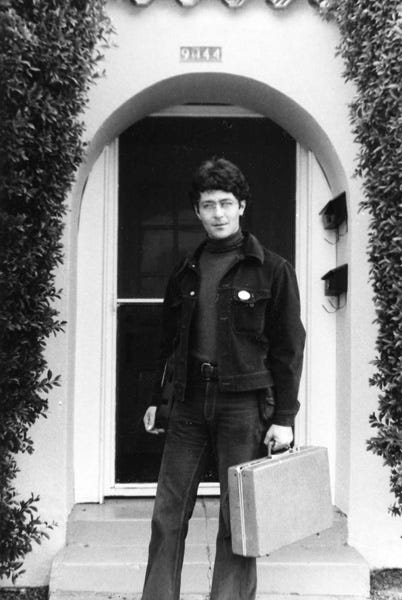
While Ivers’ influence was paramount, the story of New Wave Theatre began years earlier with just David Jove and a camera. If Ivers was Jack Crabb, then Jove was a Keyser Söze-esque figure of elusiveness and deception. Jove was born David Sniderman in Toronto in 1942. By the 1960s, he was at the epicentre of Swinging London. With a briefcase full of drugs - weed, LSD, quaaludes, barbiturates, and of course, coke - he drifted between parties, befriended the Rolling Stones’ inner circle and began supplying the band with acid. He was soon dubbed the “Acid-King” due to the strength and quality of his product.
After being busted at Heathrow Airport with his bag of drugs, Jove was offered a deal: help set up the Rolling Stones and avoid jail time and deportation. He agreed, becoming an informant in the infamous Redlands Bust - the raid on Keith Richards’ house that led to the arrests of Richards and Jagger, along with a whole load of myths concerning Mars bars and orgies.
The press became obsessed with the mysterious “man with the briefcase,” dubbed Mr X, who never showed up to court. Richards believed he was a cop, and following a separate bust in Toronto, where Jove was caught waving a pistol, he jumped bail and fled to LA. Once there, he became fixated on freeing his wife and child from a hippie cult known as the Source Family.
Another fixation was Aleister Crowley and the occult. Crowley’s popularity peaked during the sexual revolution - David Bowie was an admirer, and his visage featured on the album cover of The Beatles’ Sgt. Pepper’s Lonely Hearts Club Band. Jove’s interest in magik reflected his personal philosophy: you determine your own definition of good and evil.
In LA, Jove reinvented himself as a multifaceted artist, working across film, music, acting, sculpture, and dabbling in mysticism. His musical career never took off: two solo albums, a studio band called Oxygen with Billboard magazine director Ed Ochs, and work on an independent film score brought little success. His forays into film were equally unremarkable, though they revealed his uncompromising commitment to experimentation and outsider structures - qualities that would later characterise New Wave Theatre‘s approach.
As punk took hold of the city, he took it upon himself to document the action across LA’s clubs. A scrawny guy with intense eyes that bore like a shark’s, he enticed fear in people: it was as if he could see straight through their skulls and into their brains. Jove became both an object of intrigue and fear for many of the city’s scenesters.
He lived in a windowless storefront painted black and red. It was known simply as The Cave. Decorated with doll heads, satanic trinkets - such as a pentagram on the floor - bullet holes, and with insect noises piped through speakers, The Cave was unsettlingly thick with the scent of eucalyptus.
It became a late-night crash-out point; a 24-hour, drug-fuelled haven where guns and piles of cocaine lay openly on the table. Accessible only through a back-alley door, secured with an assortment of chains, bolts and padlocks, visitors were often greeted by Jove’s warning: “Don’t let the flies out!” Some were drawn to the chaos; others stayed far away.
The Cave was also where New Wave Theatre took shape. Jove’s handheld camera never stopped moving; his unique technique was one of constant motion, darting in and out of performances, restless and invasive. Ed Ochs, the show’s original - and short-lived - host, was quickly driven away by Jove’s suffocating intensity.
The first season, produced on public access, suffered from amateur lighting and its DIY aesthetic - sometimes you could barely see Peter or the band. By the second season, performances and Ivers’ ramblings were intercut with subliminal messages and random footage of space launches and atomic explosions. Too raw for prime time, it was relegated to a late-night slot—where it found exactly the audience it was always meant for.
///
Thanks for reading.
Fancy joining our growing team? Drop us a message or an email to find out how you could write for Pop Valley.
popvalleypress@gmail.com
Instagram: popvalleypress