

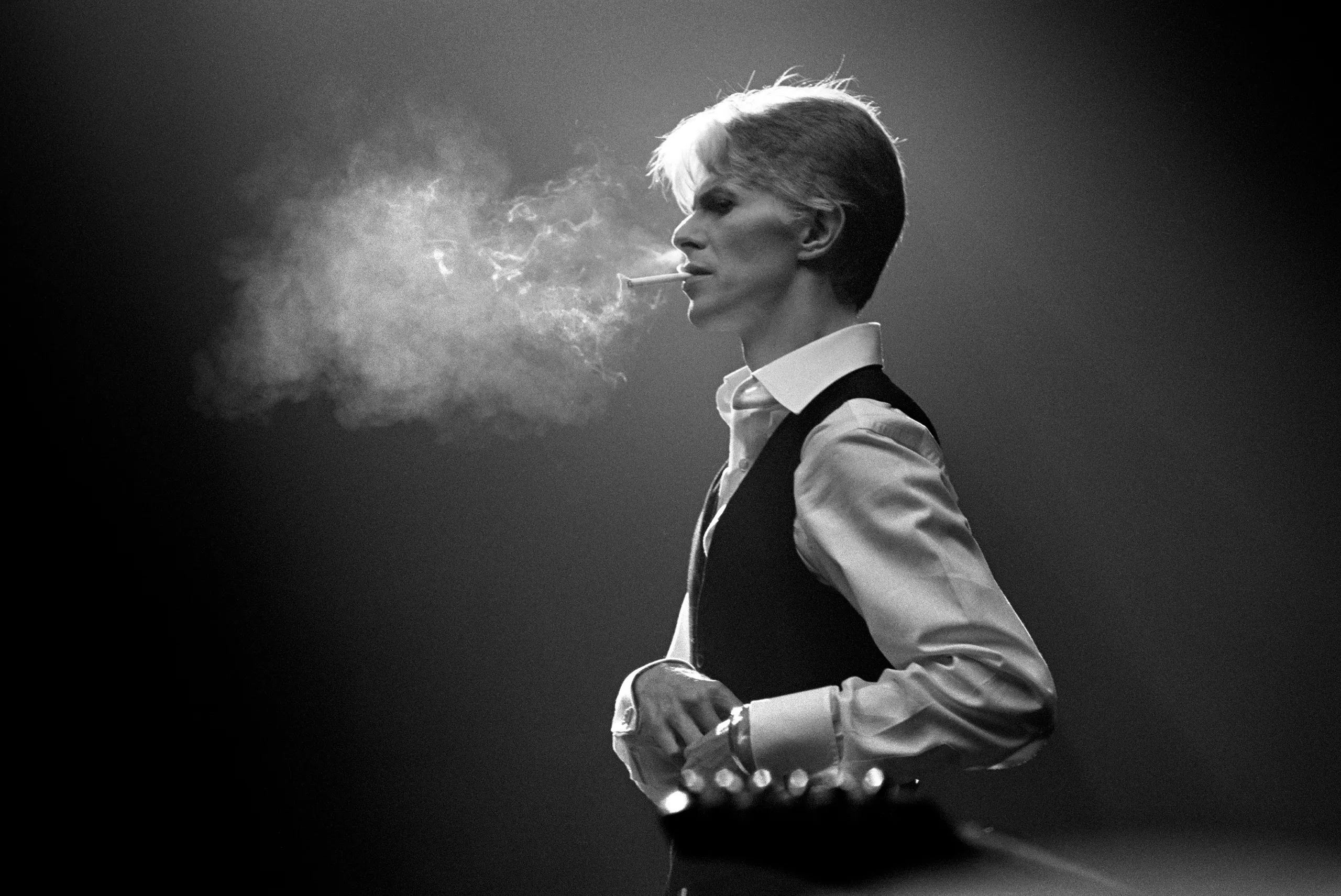
Cocaine. And lots of it. So much, in fact, that Bowie himself could barely remember anything beyond flashes of recording Station to Station. It feels fitting for an album that takes listeners on a haunting voyage through occultism, mysticism, Gnostic belief systems, and the fucked up psyche of its creators’ darkest alter ego. The mythology surrounding the record only adds to its allure and helped cement it and the Thin White Duke as teenage fixations. While Station to Station itself took time to appreciate due to its lengthy tracks and experimental leanings, Bowie’s look during this period was love at first sight. The slicked-back blonde hair, clean, cabaret-ready silhouettes, and an elegantly wasted aesthetic, topped off with a dangling cigarette, were irresistible. After swapping New York for LA and fully immersing himself in the city’s darkness - the underbelly beneath the showbiz sheen - it was hard not to be taken with an artist who had, by his own admission, “fallen into the bowels of the earth”.
Following the success of Young Americans, Bowie found himself in the rare position of near-total creative freedom. The album was recorded over several months, as, unlike its predecessors, he didn’t feel the need to rush the process. Rather than arriving at the studio with complete songs, he came with fragments, toying around and reshaping them as recordings progressed. Sessions often ran late into the night, aided by a steady supply of stimulants that allowed for 24-hour-plus marathons. At one point, he even moved a bed into the studio. This unfamiliar, haphazard approach, combined with the ‘cut-up’ technique he had recently borrowed from William S. Burroughs, lends the songs a detached quality, some of which feel curiously devoid of spirit in the most fascinating ways.
At over 10 minutes long, the title track begins as a slow, droning march before transforming into a prog-disco, blue-eyed soul groove of celebration, merging the funk of Young Americans with the krautrock, avant-garde stylings of his forthcoming Berlin trilogy. We’re taken on a trip through the Tree of Life in a medley of eerie ideas, peppered with references to Kabbalah and Aleister Crowley, while introducing the Thin White Duke - a figure designed to well and truly kill off Ziggy Stardust. “It’s not the side effects of the cocaine, I’m thinking that it must be love,” Bowie croons during the track’s second half before repeatedly declaring, “It’s too late.” Too late for what? Too late for love or any emotion? This is a character who “throws darts in lovers’ eyes”: an emotionless Aryan superman and deranged aristocrat who, despite his romantic songs, feels nothing. While Station to Station is an album of love songs, its protagonist has no love in his own life - “dry ice masquerading as fire”.
Reportedly written for Elvis, ‘Golden Years’ blends doo-wop influences with lyrics that convey isolation and the protagonist’s promise of a brighter future to his lover. Beneath its initially cheery exterior lie dark undertones and a sense of regret (“Run for the shadows in these golden years”), while musically it again brings a grinding edge to Bowie’s blue-eyed soul fixation with a hint of krautrock in the main riff. A sudden shift in pace, ‘Word on a Wing’ channels a very real, coke-addled spiritual despair. Penned on the set of The Man Who Fell to Earth, the song is an outburst against the factors Bowie felt aggrieved by while starring in the film. It stands as a raw meditation on God and Christ. Given his severely decaying mental state at the time, it’s not hard to see why his mind drifted in this direction. Just look at the Cracked Actor documentary, where a twitching, skeletal Bowie, constantly sniffing, looks lost inside a character. Terrified of elevators, surviving on milk and peppers, weighing just 80 pounds, not sleeping for up to four days at a time, and severing friendships with Keith Moon, John Lennon and Harry Nilsson (addicts themselves) because of his escalating usage, this was a man teetering on the edge of the world.
‘TVC 15’, often considered the album’s odd one out - a judgement I’ve always found puzzling - injects a dose of surreal comedy with its tale of a girlfriend eaten by a TV set, paired with Bowie’s trademark spaciness (think Lou Reed meets disco). Meanwhile, ‘Stay’s stylish production contrasts lyrics that expose the protagonist wracking self-doubt as he begs his lover to stay with him, knowing it might be the last time he sees her. A cover of ‘Wind is the Wind’, made famous by Nina Simone, brings the album to a sweeping, dramatic close with Bowie delivering one of the most impassioned performances of his career. The record incorporates a mishmash of everything great about pop music, providing the genre with perhaps its darkest moment. In embodying pure evil, the Thin White Duke becomes a sinister mouthpiece for Bowie during his most unhinged period.
Controversy arose before the album’s release when Bowie, seemingly swallowed whole by the character, made statements that appeared to sympathise with Hitler and Nazi ideology. Alongside being photographed in London mid-wave in what resembled a Nazi salute, he gave a Playboy interview to Cameron Crowe in which he claimed he “believed very strongly in fascism” and described Adolf Hitler as “one of the first rock stars.” Bowie and the Thin White Duke were consequently met with widespread outrage. As early as 1976, he began disowning these comments, stating they were misunderstood and intended as theatre. That same year, Bowie fled to Berlin in an effort to escape cocaine and LA - a city he later remarked “should be wiped off the face of the earth.” Soon after, the Thin White Duke faded away, perhaps retreating to the shadows he was summoned. Or perhaps he always remained a part of his creator: a dark enigma forced into suppression.
Thanks for reading.
Fancy joining our growing team? Drop us a message or an email to find out how you could write for Pop Valley.
popvalleypress@gmail.com
Instagram: popvalleypress