

With the 2026 UK festival season now well underway, I find myself thinking back to Coachella. Now the dust has settled on the valley, I am left contemplating wider gendered expectations of performance in popular music. This year, out of the three headliners, Justin Bieber seemed to attain the biggest crowd and most hype. Justin’s set, stage production-wise, was minimal.
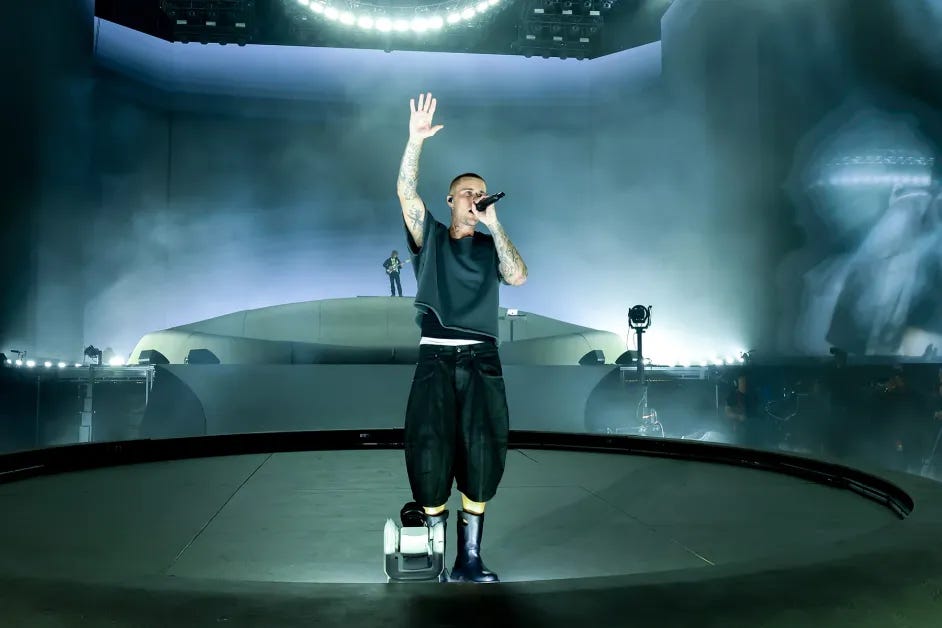
The aspect that seemed to warrant the most attention online was his playing of YouTube videos, some of his old songs, but also some viral memes. The karaoke moments of him singing ‘Baby’, ‘Never Say Never’, and ‘Beauty and a Beat’ felt like a deliberate reference to his come-up; a nice full-circle moment with him being one of the first major artists to ascend from the democracy of YouTube. However, the resultant discourse felt decidedly gendered. Some of these reactions were light-hearted:
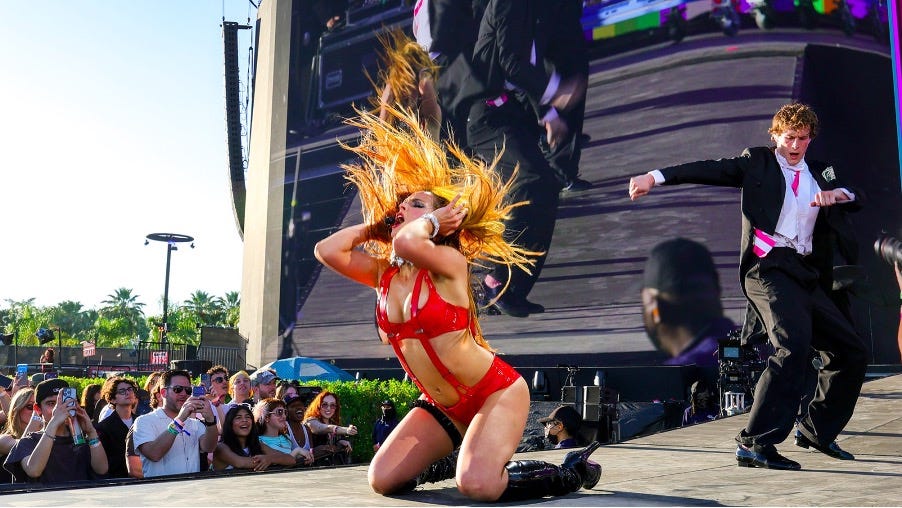
Although there was more to Justin’s performance than just playing YouTube videos, it seemed nowhere near the elaborate production the two other headliners, Sabrina Carpenter and Karol G, displayed. Sabrina and Karol had costume changes, acted interludes from Hollywood stars, dancers, elaborate lights, and various structures that filled the stage and added visual interest. Some online commentary made angrier comparisons between performance expectations for men and women:

Would a woman get criticised for adopting Justin’s minimalist performance aesthetic? Demonstrably, they are criticised even if they put on more of a show. For example, some reactions to Addison Rae’s Coachella performance speak to this. Festival vloggers TPD rated her set as the worst they saw all weekend, saying she had “all the swagger of one of the major pop girlies but with a karaoke-ass voice. 1/10”:

 Tiktok failed to load.
Enable 3rd party cookies or use another browser
Addison’s sets are always decidedly dramaturgical, but since the first night of her tour, she has attracted denunciation for her lack of technical singing ability. But maybe that isn’t the focus of her performance. The headset mic she wears on stage is a great signifier of this. Instead of holding something traditional like an SM58, she wears a hands-free headset microphone, à la Britney Spears. This frees up the rest of her body for dancing, which is how she became famous in the first place. The music, stage design, and choreography seem to be the main drivers of her aesthetic ideology – not perfect breath control or accuracy of pitch.
So, if we take @platypusperry’s prediction seriously, the gender expectation gap seems to manifest more intensely - female artists can focus more on theatrical performativity, but they still have to be stellar vocally as well. I am not accusing TPD of being misogynistic in any way; it just shows how gender can affect how we want an artist to perform. There are a plethora of male artists who are regarded as some of the greatest musicians of all time that are not traditionally ‘good’ singers, like Bob Dylan, Lou Reed, and Tom Waits, to name a few. If, with these male artists, their audience does not demand them to be melodically precise or hide their intakes of breath, what do they demand?
Dylan, Waits, and Reed, who write their own songs, have been praised by the listening public over the years for their authenticity. What they are not praised for is displaying any kind of vivid and dynamic spectacle. Yet, just because they do not have thirty back-up dancers, fireworks, and perfect choreography does not mean they aren’t performing. The very structure of and the divide between stage and audience naturally codifies any expression on stage as a performance. I would argue that many would consider someone like Dylan to be particularly nonperformative, presenting their true self through their music. Really, they are just performing a masculine ideal of authenticity.
Another way they present authenticity is by performing songs they have written. Song-writing, which for this purpose can be framed as an expression of the self through a creative process, is heavily tied to authenticity. Emma Mayhew writes:
“The musician/performer is positioned as the creative artist, with the music representing a “truthful” reflection of the artist’s talents and personal expression. Thus, the discourse of authenticity universalises, but in combination with a notion of creativity it does so through constructing individual uniqueness” (1999, pg. 65)
There is not the same demand for women to write their own songs. According to a post on the USC Annenberg website, women make up just 19% of songwriters on the Billboard Hot 100 as of 2024. Admittedly, I have just compared female pop artists with more rock-centric male ones here, and genres have varying performance expectations regardless of gender. But this dichotomy can help us understand how Justin attains this masculine authenticity within the pop-space. Maybe not Justin Bieber, but certainly for male rock vocalists, this ‘real’ reflection of the self through lyric writing is a metric of perceived authenticity. Justin grasps at the vague benchmark of authenticity in other ways. Him showing the audience YouTube videos infers an air of casualness, of not needing to put on a show for his fans, that his unadulterated self is enough. This is paralleled by Justin’s performance at the Grammy Awards this year, too, where he played ‘YUKON’ in his boxer shorts and socks, with a sampler, pedalboard, and mirror being the only things adorning the stage.
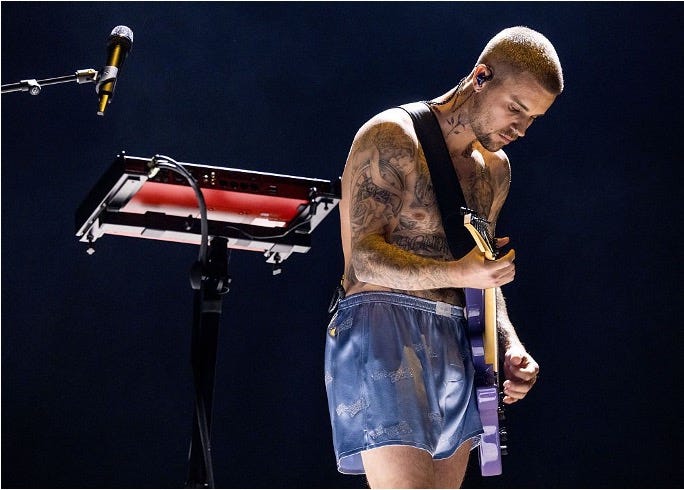
This stripped-back-ness is how Justin performs this authenticity of self. Whereas the aforementioned male rock vocalists avoid vocal perfection to perform authenticity, Justin eschews the ostentation of pop stage design and choreography to perform his own authenticity.
Overall, women are expected to perform a performance, whereas men are expected to perform authenticity. Is this demand for the feminine spectacle and masculine expression in popular music because the patriarchy socialises men as subjects - as having agency, having a voice - as opposed to women who are socialised as objects - who are watched as they perform an ideal, rather than express the self? This may be. But these gendered trends and expectations are merely thus. Since the 1980s, Butler has expounded how performative the idea of gender is, that it is “in no way a stable identity ... rather, it is an identity tenuously constituted in time—an identity instituted through a stylised repetition of acts” (1988, pg. 519). Some of Bourdieu’s theory in The Field of Cultural Production highlights how dominating structures in society, such as the patriarchy, impose aesthetic tastes aligned with those ideologies, naturalising their superiority (1994).
This is how we can understand the gendered expectations regarding authenticity and performance to have emerged. If gender is a performance of certain archetypes in everyday life, then this naturally translates to the ceremonious and intentionally performative situation of a pop concert. We expect certain things from male pop stars, but maybe we expect more from women.
///
Thanks for reading.
Fancy joining our growing team? Drop us a message or an email to find out how you could write for Pop Valley.
popvalleypress@gmail.com
Instagram: popvalleypress
