

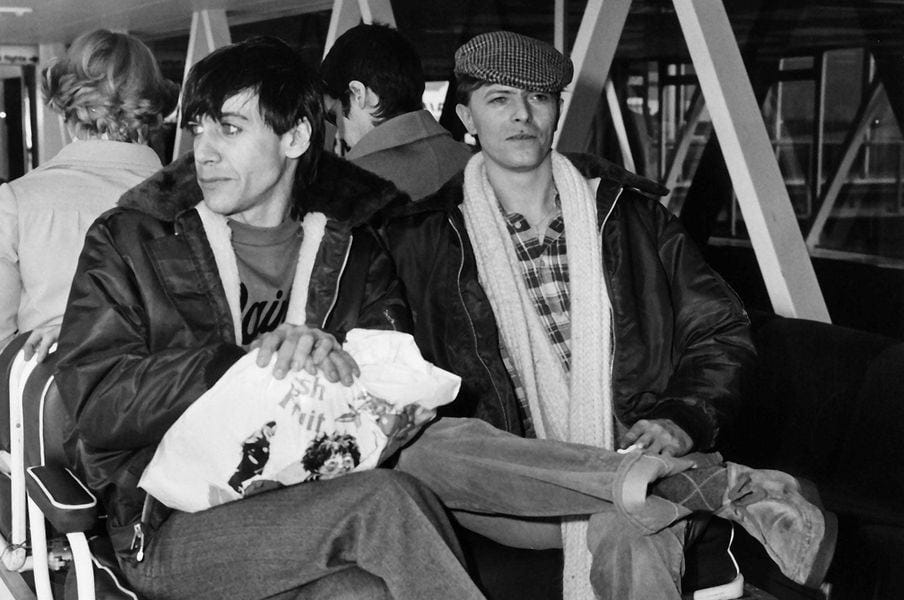
In 1976, on the verge of mental and physical disintegration, David Bowie decided to leave behind the bright lights of LA in an effort to rid himself of the cocaine-fueled isolation and toxicity that had consumed his life there. Accompanied by a similarly strung-out Iggy Pop, the pair headed for West Berlin, determined to strip down their lives and wash away every shred of America. During his three years in Germany, Bowie produced Pop’s crucial first two solo albums, recorded what became known as his “Berlin trilogy,” and on this day in 1977, released one of the greatest tracks in modern music history: “Heroes.”
A slow, droning buildup sets the tone. Chattering synths wash over an atmospheric guitar line, wailing and siren-like, creating a sense of urgency. Built around an oscillating riff, the track is stark, emotional, and reminiscent of wandering an urban street late at night. Bowie's vocals, calm and intimate at first, gradually turn into pained screams. It’s an arresting performance that astutely captures the song's contradictions. While the title “Heroes” reflects its creators' optimistic mood since walking himself back from the brink of insanity, the quotation marks undercut it, adding a level of irony that pokes fun at the idea of heroism. The protagonist is no superhero, no Ziggy Stardust. In “Heroes”, Bowie speaks plainly, freely admitting regrets, faults, and vices, but also hints at finding freedom in ridding himself of his past characters and coming back to himself. On one hand, the song conveys the hope that things can get better, even if it’s “just for one day.” On the other hand, it accepts the inevitable: “nothing will keep us together.”
By the time Bowie arrived in Berlin, he was facing financial ruin. Years of cocaine abuse, the mounting costs of his extravagant tours, and a disastrous contract with manager Tony DeFries-one that left him personally liable for his management company’s expenses-had hollowed him out. He instructed his PA, Coco, to find the largest, cheapest flat available and ended up in the unfashionable, working-class district of Schöneberg. For the first time in a decade, rent was now a factor. In both the literal and metaphorical sense, he stripped himself bare. His famed outlandish designer garbs gave way to plain shirts and jeans, as for the first time in his life, he made an effort to blend in. With cocaine off the cards, he made the classic addict error of swapping one addiction for another. He frequented sad bars filled with sad people, sometimes crying about the leeches who were bleeding him dry and sometimes getting held up by his breeches while he threw up in a back alley. While it all sounds quite bleak, this was only one side of the coin, and it was this backdrop that fuelled the creative fire that burned throughout his years in Berlin.
Iggy Pop, his closest companion, played a vital role in his rejuvenation. Eager to get stuck into something outside of himself, the ex-Stooges frontman became a kind of guinea pig for Bowie to test some of his more experimental ideas while acting as producer on his solo albums. After Iggy moved into one of the seven rooms of Bowie’s flat, the pair explored Berlin together and spent their time out of the studio visiting the city's vast array of late-night bars, coffee shops, cinemas, and theatres. They shared a fraternal rivalry, arguing like siblings yet admiring in each other what they lacked in themselves. Iggy’s gift for spontaneous, improvisational lyricism-a kind of verbal jazz-fascinated Bowie, and it was a technique he sought to emulate when recording Heroes.
The album and its title track were recorded at Hansa Studios in West Berlin. Nicknamed ‘The Hall By The Wall’ due to its proximity to the Berlin Wall, the studio became a constant source of inspiration. Once a grand chamber hall that had hosted concerts, readings, and even Gestapo parties during the Second World War, it had fallen into disrepair by the late 1970s. Bricked up and pigeon-infested by the time Bowie arrived, to the naked eye, it might’ve looked like an unorthodox choice to record an album. Yet its cavernous walls and marble drum room offered a unique acoustic environment, and its state-of-the-art equipment made it an ideal home for experimentation. The ever-present procession of tanks rolling past, Russian guards peering through binoculars, and the looming threat of a Stasi raid kicking down the doors at any second made the process feel like recording in a warzone. However, to Bowie and his team, it was an adventure. The fact that Hansa was dirt cheap-roughly a twelfth of Abbey Road’s cost-was the icing on the cake. Heroes became the only album in the “Berlin Trilogy” to be recorded entirely in Berlin.
For years, Bowie claimed the lovers in “Heroes” were fictional. In truth, their origins were far more personal. In the summer of 1977, while struggling with writer’s block in Hansa’s Studio 2, Bowie asked everyone present to leave, particularly his producer Tony Visconti and Visconti’s lover, Antonia Maass. At the time, Bowie was enduring a painful separation from his wife, Angie, and the couple’s soppy displays of affection were becoming a source of irritation. Left alone, he gazed toward the nearby Berlin Wall for inspiration. Dwarfed by the concrete dividers, barbed wire, and harsh concrete, he noticed a couple kissing-a startling contrast to the desolation and oppression around them. The image reminded him of Lovers Between the Garden Wall, a painting by German Expressionist Otto Mueller, infused with a similar, bittersweet melancholy. He soon realised the couple were Tony and Antonia and was touched by the love his friend had for his lover. Forbidden love, perhaps, since Visconti was married, but deeply moving nonetheless. To Bowie, their embrace echoed the kind of fleeting, doomed love two people separated by the Wall might share. By the time the pair returned, the lyrics were finished.
Upon release, “Heroes” was a relative commercial disappointment. Today, it stands as a bona fide classic-a song that somehow reveals something new with every listen.
Thanks for reading.
Fancy joining our growing team? Drop us a message or an email to find out how you could write for Pop Valley.
popvalleypress@gmail.com
Instagram: popvalleypress