

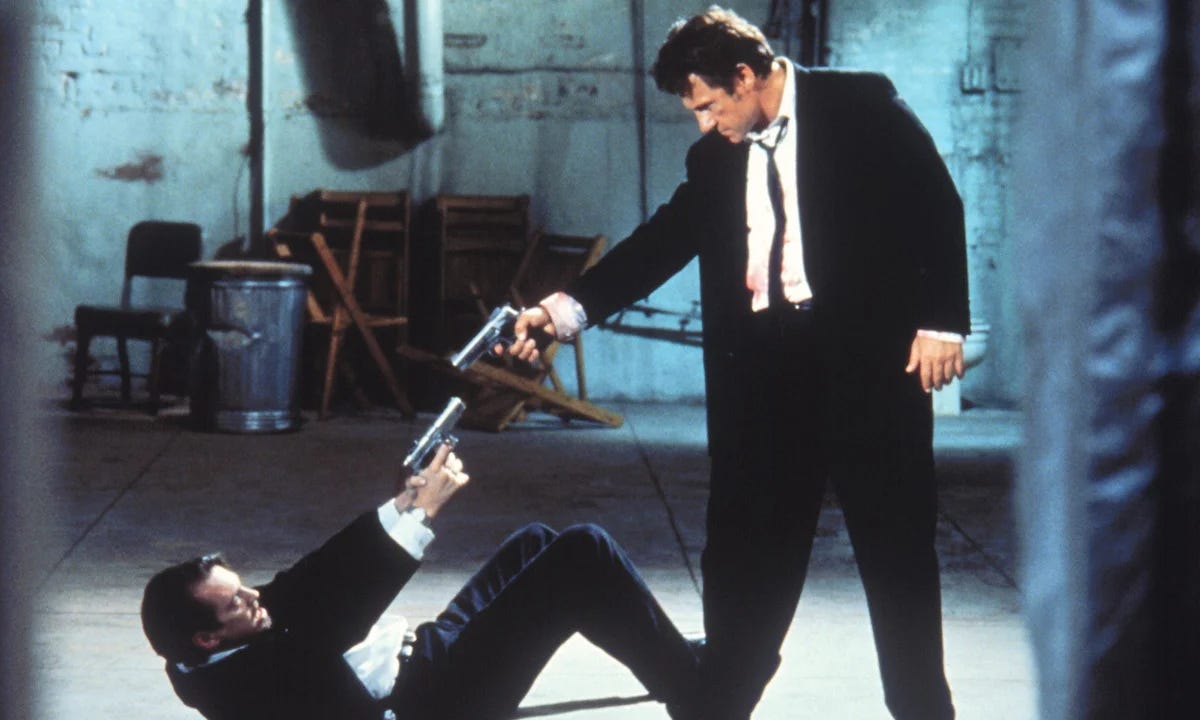
Once heralded as “The Greatest Independent Film of All Time” by Empire magazine, Tarantino’s 1992 debut remains a landmark in film history. From its now-iconic diner chat about Madonna’s ‘Like a Virgin’ and tipping culture - brimming with dialogue that blends poetic flair with street-smart realism - to the slow-mo stride of the suited cast as George Baker Selection’s ‘Little Green Bag’ plays over the opening credits, Reservoir Dogs signalled the arrival of a unique, exciting and poised filmmaker.
Initially devised as a $30,000 project between Tarantino, a film enthusiast and ex-Video Archives employee with no formal training, and his friends, the Reservoir Dogs script soon found its way to Harvey Keitel. Keitel was so impressed that he not only agreed to star in the film, but also signed on as a co-producer, giving the project the legitimacy it needed to eventually secure a $1.5 million budget. Among a cast teeming with talent, Keitel stands out as the unusually sympathetic career criminal, Mr White. The role came in the same year he delivered a hauntingly raw performance as a corrupt cop splitting at the seams in Abel Ferrara and Zoë Lund’s Bad Lieutenant, one of the grimiest films of the decade.
Despite its modest budget, Reservoir Dogs thrives in its limitations. The use of just a handful of locations allows the spotlight to shine on Tarantino’s now signature conversational dialogue - steeped in pop culture references, humour and wit - and the chemistry of its masterful ensemble cast. Another Tarantino trademark that would be perfected in his 1994 follow-up, Pulp Fiction, was the film’s shifting timeline - a creative solution to avoid depicting the central and potentially costly bank heist (a solution that perhaps owes its dues to Glengarry Glen Ross). By giving the audience a god-like knowledge of the characters’ fates, a sense of inevitability is created, something that heightens the tension of each violent outburst and interaction. Along with its jarring tonal shifts - from dark comedy to senseless brutality in a matter of seconds - Reservoir Dogs is a taut and unpredictable cinematic experience.
Reservoir Dogs, like the majority of Tarantino’s filmography (to varying degrees of success), openly acknowledges its inspirations while still retaining a fresh and original spirit. Along with visual nods to the sharp style of Alan Delon and Jean-Pierre Melville’s crime films, the stylised sadism of spaghetti westerns, and of course, Martin Scorsese’s gangster flicks, film fans will detect elements of Stanley Kubrick’s The Killing, Ringo Lam’s City on Fire, and Kurosawa’s Rashomon. While later Tarantino films can be overpowering in this homage-heavy approach, Reservoir Dogs strikes the perfect balance between representing his encyclopaedic passion with a desire for reinvention.
After earning word-of-mouth success at Sundance, Reservoir Dogs helped pave the way for the wave of independent cinema that prevailed in the 1990s. Along with Pulp Fiction, which returned $200 million on its $8.5 million budget, Reservoir Dogs helped convince producers that original and inexpensive works can be profitable - something that allowed indies such as Go, Trainspotting, and British gangster flicks like Layer Cake and early Guy Ritchie films to succeed. More than 30 years on, Reservoir Dogs remains a bold and electrifying example of how far good writing, a strong vision and keen actors can take you, and continues to influence both filmmakers and lovers alike.
Thanks for reading.
Fancy joining our growing team? Drop us a message or an email to find out how you could write for Pop Valley.
popvalleypress@gmail.com
Instagram: popvalleypress