
I’ve taken my time to sit with cinema. Previously there was apprehension; my malaise regarding the industry negated any desire to enjoy the medium in its actual form — free from reviews full of decorative language designated to inform a certain minority, perpetuating a lineage of exclusivity through terminology. But I’ve sat with it now, and I understand my sensitivities may have created a blind spot in considering film worthy of my attention out of retrograded moral high ground that can be reviled simply by studying the median itself and learning the language without the pretension that often accompanies it.
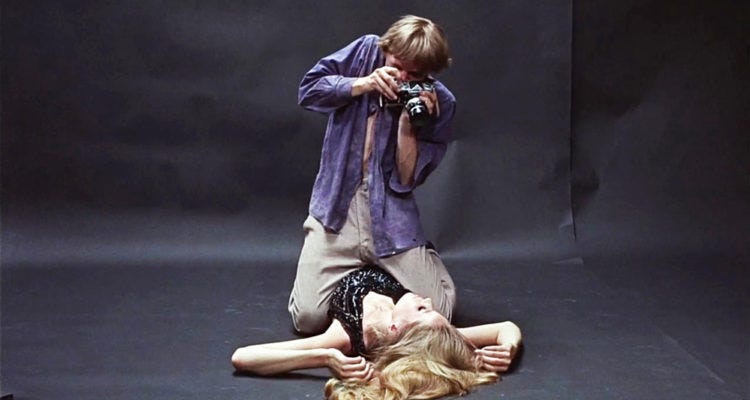
To confront my indifference, I instructed myself to watch Michelangelo Antonioni’s Blow-Up (1966). I had seen a myriad of screencaps circulating on Tumblr and Pinterest prior to my self-imposed study, alongside its poster that became an eminent visual of the 60s era. I began with the opinion that the storyline was eccentric - I wasn’t sure where I was being driven to and whether its eccentricity was a good thing. It appeared to lack direction. In irony or perhaps in intention, Thomas {the main character, a photographer of aspiring models - mannequins} is himself caught in a lack of direction. Tired of his quotidian affairs that bring no real aim, he finds vivacity through the intrusion of capturing pictures of a couple in a park.
The development of these blown-up images soon appears to reveal a murder. Thomas, still enjoying the sensual pleasures of swinging London, is unable to shake the intrigue as he reads a story that is being told through his own eyes. The initial lack of direction gives way and is replaced with the same resurrected curiosity that Thomas experiences. Yet this excitement reaches an impasse when his studio is ransacked - the suspect leaving only a negative depicting an apparent body. Convincing a friend to seek out the body he had witnessed - they find nothing. His final images for publications are marred and the possibility of adventure is torn away.
The film ends with Thomas watching mimes playing the role of tennis players with a separate group of mimes acting as observers, gesturing towards a ball that is a nullity. The ball eventually escapes the court and falls near him. The mimes stare with apprehensive countenance — will he enact a farce? Will he play along to an act to which there is only imagination? He is alone and there is an impression that he, like the others, believes in the reality of the ball. He chooses to chase it and throws it back, the camera now showing him desolate in a field that appears infinite. He listens to the sound of the imagined ball. He is alone and in search of something outside of himself.
After watching, I got it. Whether it was this particular film that elicited such a response or whether any film could’ve done so, I’m unsure. Regardless, I found myself reviewing it the way a critic may, enjoying it the way a fanatic would - the way one can interpret literature, fine art, music. I didn’t feel intellectual insecurity the way I might’ve if I had read reviews beforehand, revering the film through someone else’s interpretation. Maybe my approach was myopic - and this was the first film to show me so.
Find Emily on:
Substack - emily violet
Instagram - emilyvwillow
Thanks for reading.
Fancy joining our growing team? Drop us a message or an email to find out how you could write for Pop Valley.
popvalleypress@gmail.com
Instagram: popvalleypress