

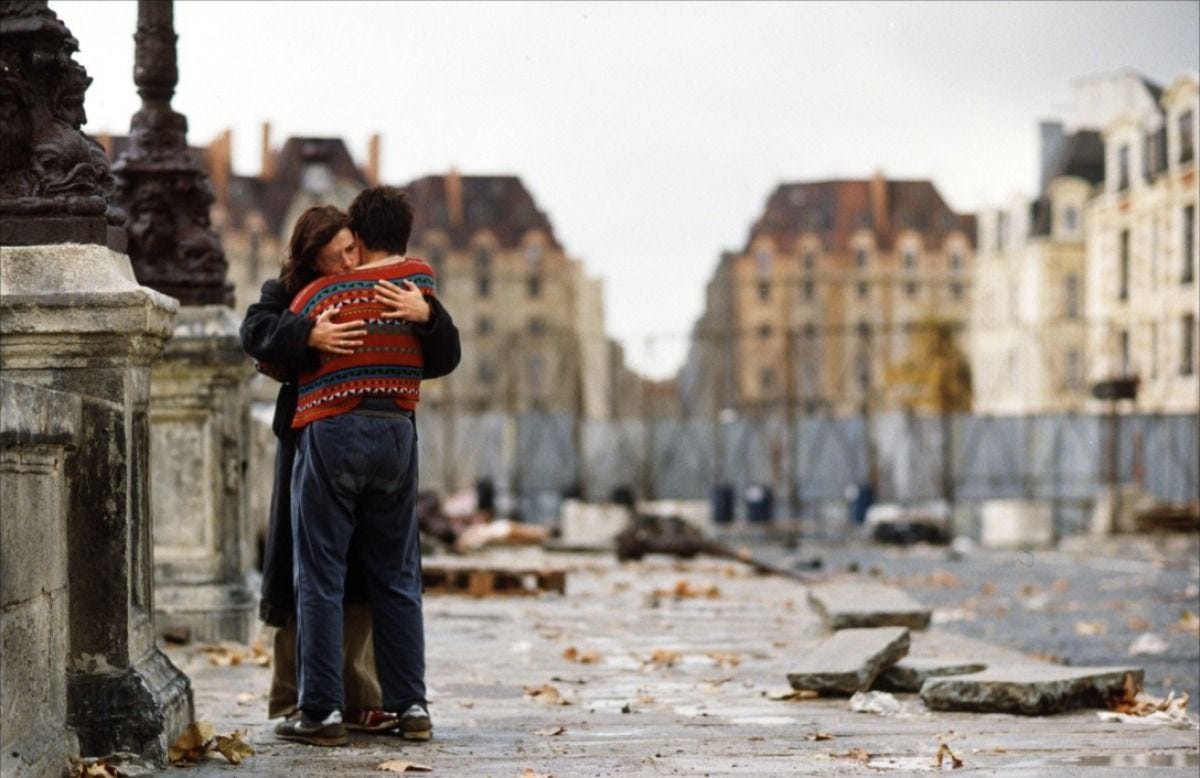
Leos Carax’s genre-bending classic, The Lovers on the Bridge (Les Amants du Pont-Neuf), is, on the surface, a straightforward boy-meets-girl tale. Only in this case, the boy, played by Denis Lavant, is a homeless street performer crippled by addiction to alcohol and sedatives, and the girl, portrayed by Juliette Binoche, is a runaway painter slowly losing her sight - and also homeless. Both are drifting through life on the streets of Paris and soon become bound together by their desperation and longing for companionship.
In our first encounter with protagonist Alex (Lavant), he stumbles through the Parisian twilight, his face a picture of defeat, anguish, and exhaustion. There’s a close-up as he grates his forehead against the tarmac in the middle of the street until he bleeds.. Moments later, he lies in the road, and his leg is obliterated by a speeding car as Michèle (Binoche) watches on. Taken in by a van of vagrants bound for a flophouse, both the audience and Alex enter Carax’s grim projection of Paris’s underbelly - a feral underworld of forgotten men and women, lost to addiction, poverty, and disregard. Yet despite its visceral bleakness, The Lovers on the Bridge is imbued with moments of magic, wonder, and lyricism amid its squalor. Fittingly, for a film that defies genre expectations with a huge middle finger to convention, The Lovers on the Bridge endured one of the most chaotic and unorthodox productions in European film history, becoming a tale of artistic obsession and collapse in its own right.
What began as a modest black-and-white project shot on Super 8 ballooned into an extravagant epic that reportedly cost between 100 and 200 million francs (making it the most expensive French film ever produced at the time). Carax conceived the idea in 1987, initially as a small, personal story. Carax’s insistence on filming at Paris’s oldest standing bridge, the Pont Neuf, was in equal measures visionary and imprudent. When the city denied his request to close the bridge for three months, Carax decided to build a full-scale replica for the nighttime scenes. Requiring a bridge in the middle of Paris was always going to be difficult, but it’s doubtful anyone expected it would take almost four years to complete the film.
Set designer Michel Vandestien settled on the suburban town of Lansargues in southern France to build the replica at an estimated cost of 32 million francs. Using forced perspective, he recreated the surrounding Parisian streets and embankments with precision. The set included the equestrian statue of Henri IV, a façade of the La Samaritainedepartment store, the entrance to a metro station, and even a recreation of the nearby Vert-Galant park (complete with real trees). Another landmark was achieved as it became the largest film set ever built in France.
In the film’s first quarter, a walking stick–wielding Alex manages to scale the blocked-off bridge and return to his spot, the boundaries between art and life were becoming all the more blurry. The French police and mayor granted Carax a three-week permit to film at the Pont Neuf in August 1988, one that couldn’t be extended due to upcoming renovations. Around this time, Denis Lavant was injured while engaging in private carpentry work, leaving him unable to film during the crucial shooting period. Production ground to a halt, and insurance payouts were insufficient to keep the project afloat.
By December 1988, filming stopped completely. Only fourteen minutes of footage had been recorded. An interim period ensued during which Carax circulated the videocassettes to rouse interest and potential funding. The footage received praise from Steven Spielberg and Patrice Chéreau and eventually caught the attention of Swiss millionaire Francis von Buren and French film producer Dominique Vignet, who invested 30 million francs. The story of Alex and Michèle’s anarchic love could finally begin to take shape. On screen, their passion reaches its zenith in the film’s most iconic moment, a Bastille Day fireworks scene that explodes in colour, madness, and joy. The sequence, like much of the film, is unforgettable due to its excess.
Carax was no stranger to ambitious filmmaking. His debut feature, Boy Meets Girl, and its follow-up, Bad Blood, had cost 3 and 17 million francs respectively. Both were critical and commercial successes, and while Boy Meets Girl features only Lavant, the latter starred both Lavant and Binoche in leading roles. While Carax’s relationship with Binoche was initially professional, the two entered into a romance, a dalliance that lacked the stability to withstand the unrelenting chaos of filming The Lovers on the Bridge. Binoche praised Carax for his ability to keep her spirits high over the course of the long and uncertain delays, but also called him a “sadist” for the conditions he imposed on cast and crew. She broke up with him when she discovered his intended ending for the film. (In her words: “Me dead and him standing on the bridge thinking, ‘Did she ever love me?’” - something that almost came true when she nearly drowned while filming in the Seine.)
By late 1989, it became obvious that the previous cash injections were insufficient as costs had once again spiralled. It was reported that the budget up until this point was 80–90 million francs, and, as noted by Le Monde, at least another 80 million would be required to finish the film. Von Buren withdrew his funding at an 18-million-franc loss, and for thesecond time, filming stopped, this time for nearly a year. To make matters worse, storms then ravaged the incomplete set, causing extensive damage.
How does one find the motivation to carry on in the face of such Sisyphean setbacks? Carax’s determination to finish The Lovers on the Bridge mirrors the very resilience his characters display, clinging to his film amid the ruin like Alex and Michèle cling to their love. Perhaps the absurdity - and, at times, futility - of it all influenced the film’s darkest moment. As Michèle’s sight deteriorates, she relies on Alex, and he grows increasingly possessive. When her family launches a public search for her, Alex, terrified of losing her love, burns the posters and, by accident, kills a man in the process.
In a poetic twist, the production was saved by yet another act of faith. After failing to entice any financing partners, French producer and filmmaker Christian Fechner used money from his own pocket to purchase both the rights and the debts of the film. His contribution was immortalised in cinema folklore when the boat that rescues Alex and Michèle at the end of the film, after the pair fall from the bridge into the Seine, was named after him. Shooting concluded in December 1990. By May 1991, after nearly four years, The Lovers on the Bridge was finally complete. Its massive replica bridge, a triumph of set design, was destroyed soon after by the farmer who owned the land, despite the local mayor’s wish to preserve it as a tourist site.
While Fechner insisted that the final cost of the film was 100 million francs, Carax himself expressed uncertainty, perhaps simply relieved to have finished the film at all. Upon release, The Lovers on the Bridge received a mixed critical response in France and struggled commercially. Over time, it has gained certified cult status and stands as a testament to Carax’s artistic integrity (and madness). Like the bridge itself, the film is one where contradictions coexist; primarily love and decay. It embraces cinema in its rawest form and erupts with a beauty akin to the fireworks its protagonists dance beneath on Bastille Da
Thanks for reading.
Fancy joining our growing team? Drop us a message or an email to find out how you could write for Pop Valley.
popvalleypress@gmail.com
Instagram: popvalleypress