

In the wake of Reform UK’s dominance in the local elections back in May, I wrote that British left-wing politics needed someone charismatic to come in and rock the apple cart.
“They won’t necessarily even be socialist, but they’ll tackle the populists head-on, and they’ll be quick—they need to be.”
Quick, they were: as within an hour of publishing, the deputy leader of the Green Party, Zack Polanski, announced a bid to assume full leadership.
In what was a rather upmarket video production, Polanski got straight to the point and was quick to put his foot down. Within the first fifty seconds of the video, he had accused the Labour government of “failing,” insisted that “Nigel Farage and his billionaire mates” don’t offer any real solutions, and promised to “confront fascism” and “call a genocide what it is.”
A very charismatic pledge, and arguably a step into unfamiliar territory.
Whilst he did allude to environmental issues in his promo video, there was a noticeable lack of focus on tackling the climate crisis, which is so commonly associated with the Green Party. It became apparent quite early on that Polanski would spearhead a perception shift towards a bolder, more radical ideology to build a strategy around.
He adopted the slogan of “bold leadership” and was unsurprisingly endorsed by left-wing media personality and journalist, Owen Jones, two days later in The Guardian.
Zack Polanski played the campaign game well. He’s strong in debate and knows how to use social media to his advantage, and from May to July, it was reported that Green Party membership rose by 8%. On 2nd September, Polanski was elected leader in a landslide victory with 85% of the vote share.
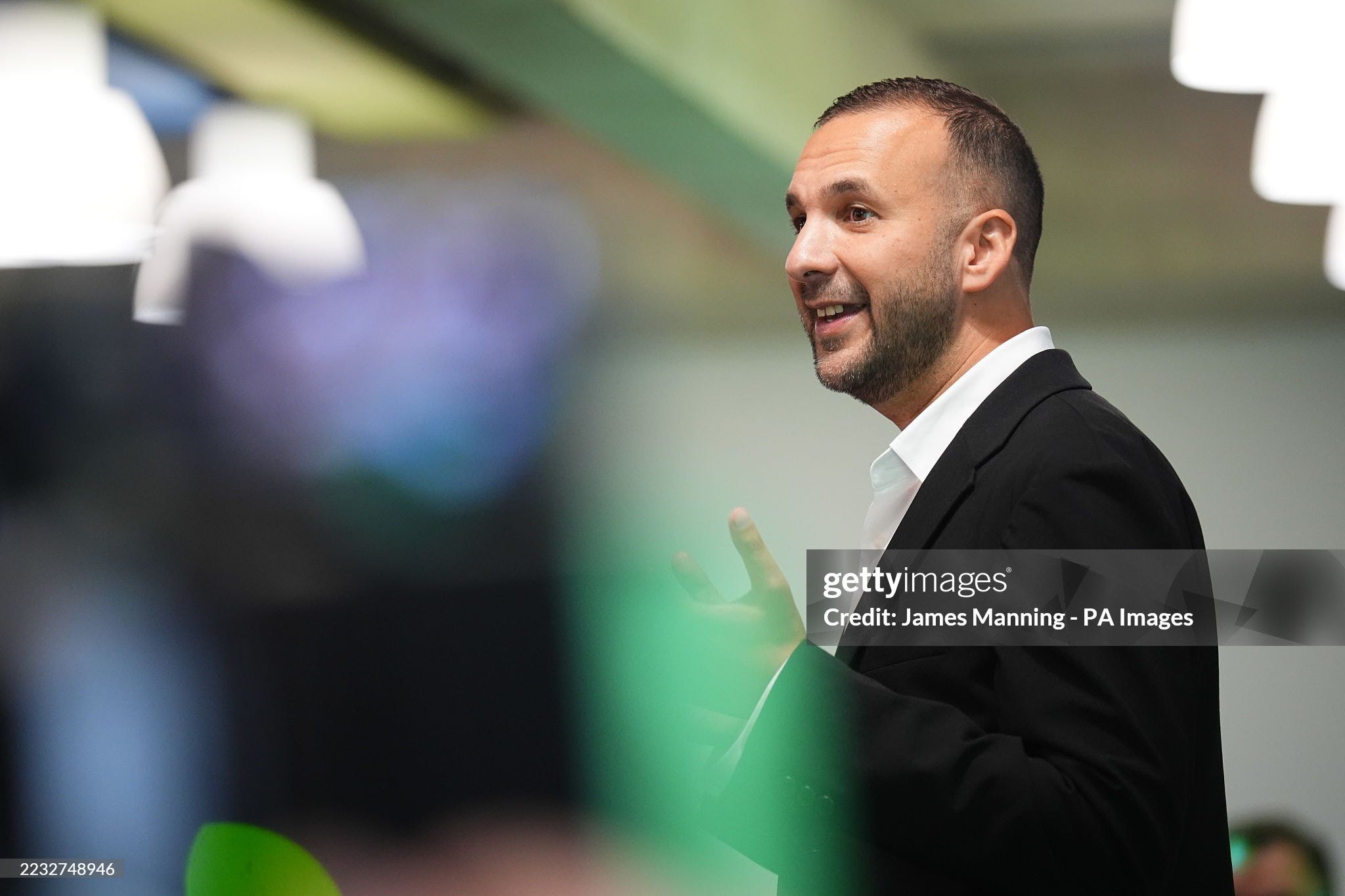
Whilst minuscule compared to the Reform UK coverage, the media did react. Polanski soon found himself on Sky News, LBC, The News Agents, and Good Morning Britain, just to name a few, and even fell victim to mockery and personal attacks from the likes of The Telegraph, and the Labour Party’s official social media accounts.
He was quizzed on policy, and he made it abundantly clear that he believes that the climate crisis is inextricably linked to the cost-of-living crisis, and you can’t solve one without the other.
But the challenges facing the UK, whilst potentially interconnected, are numerous and multifaceted, demanding careful coordination rather than a single solution.
The Green Strategy
The latest YouGov polls tell us that the three most important political issues facing Britain are the economy, healthcare, and immigration.
In the survey, British adults of various demographics were asked to select their three most important issues from a list of contenders; 28% selected healthcare, 53% selected the economy, and 56% selected immigration.
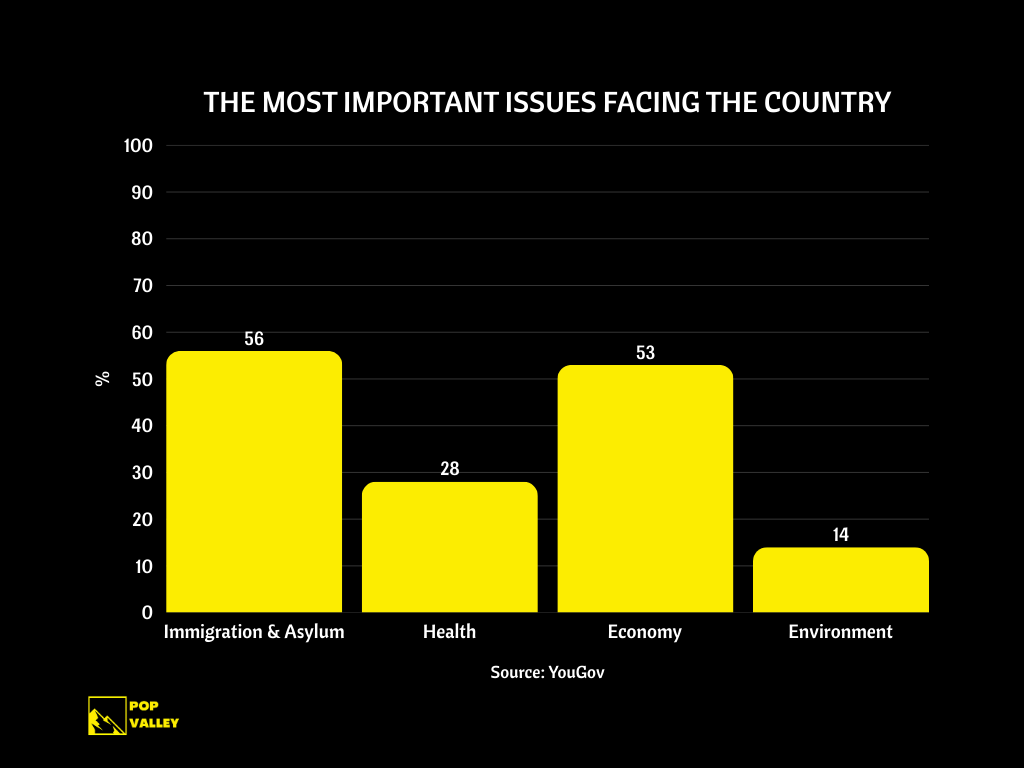
Even crime, tax, housing and defence scored higher on the priorities list than the environment—selected by just 14% of those asked—which explains Polanski’s campaign diverging away slightly from the notion that the Greens only have one sole focus.
The new Green Party leader made his economic position clear from the off: tax the rich.
Polanski supports a 1% tax increase on assets valued over £10m, and a 2% tax increase on assets valued at over £2bn. The self-described “eco-populist” has been resolute in emphasising his wishes to reduce all forms of inequality and to strive for economic justice, even vowing to nationalise the water companies.
“It’s time to say to people: we can and we will lower your bills.”
— Zack Polanski during his leadership victory speech
And the revenue generated by the asset tax increases will, according to Polanski, go towards a proposed £50bn investment into the NHS.
The biggest issue, however, could prove to be his biggest weakness.
When it comes to immigration, Polanski is of the opinion that instead of tackling the small boats crisis directly, we must instead reeducate the electorate on the effects of migration, after being fed “propaganda” on what he calls a “manufactured crisis”.
When speaking with Channel 4’s Paul McNamara, he made a relatively strong case for economic migrants, those who have come to the UK for a better quality of life, drawing on his own belief of progressive patriotism:
“We should want the country [to be] so that people want to live here.”
- Zack Polanski, speaking to Paul McNamara
Whilst the ambition is admirable, “changing the narrative” through telling “bold stories”, as the Green leader puts it, isn’t really going to satisfy people.
According to the polls, 56% of people are concerned about immigration. A rumoured 150,000 people attended the Unite the Kingdom rally last week, in protest against, whether they’ll admit it or not, immigration. Reform UK, whose whole ethos is anti-immigration, are currently in pole position in an alarming number of seats.
It’s going to take more than storytelling to win over some of those voters.
That being said, it could be argued that Zack Polanski isn’t anticipating that any of the far-right marchers would ditch their flags for Green placards. His target is elsewhere, after the Green Party boasted silver medals in forty different constituencies in the 2024 General Election, coming second in thirty-nine of those seats to Labour and the exception to speaker of the house, Lindsay Hoyle.
I spoke to Oliver Eagleton, a New York Times and Guardian-published journalist, and prominent voice in left-wing politics:
“Before Polanski's victory there was not a single Westminster party with a left-wing platform. Now, the Greens have shifted in a much more promising direction: linking the climate crisis directly to the cost of living crisis, as well as opposing Britain's violent foreign policy. The result is that, in many seats throughout the country, the Greens could plausibly channel opposition to the ruling consensus. But whether they can become a genuine party of the left is still unclear.”
- Oliver Eagleton speaking to Pop Valley
There are definitely question marks over whether or not Polanski’s Green Party can fill the left-wing void left by the current Prime Minister’s gradual right-ward shift—something that Oliver explores in his 2022 book, The Starmer Project.
The Greens will undoubtedly be pushing hard in the constituencies where they came second, but the polls currently make fascinating viewing.
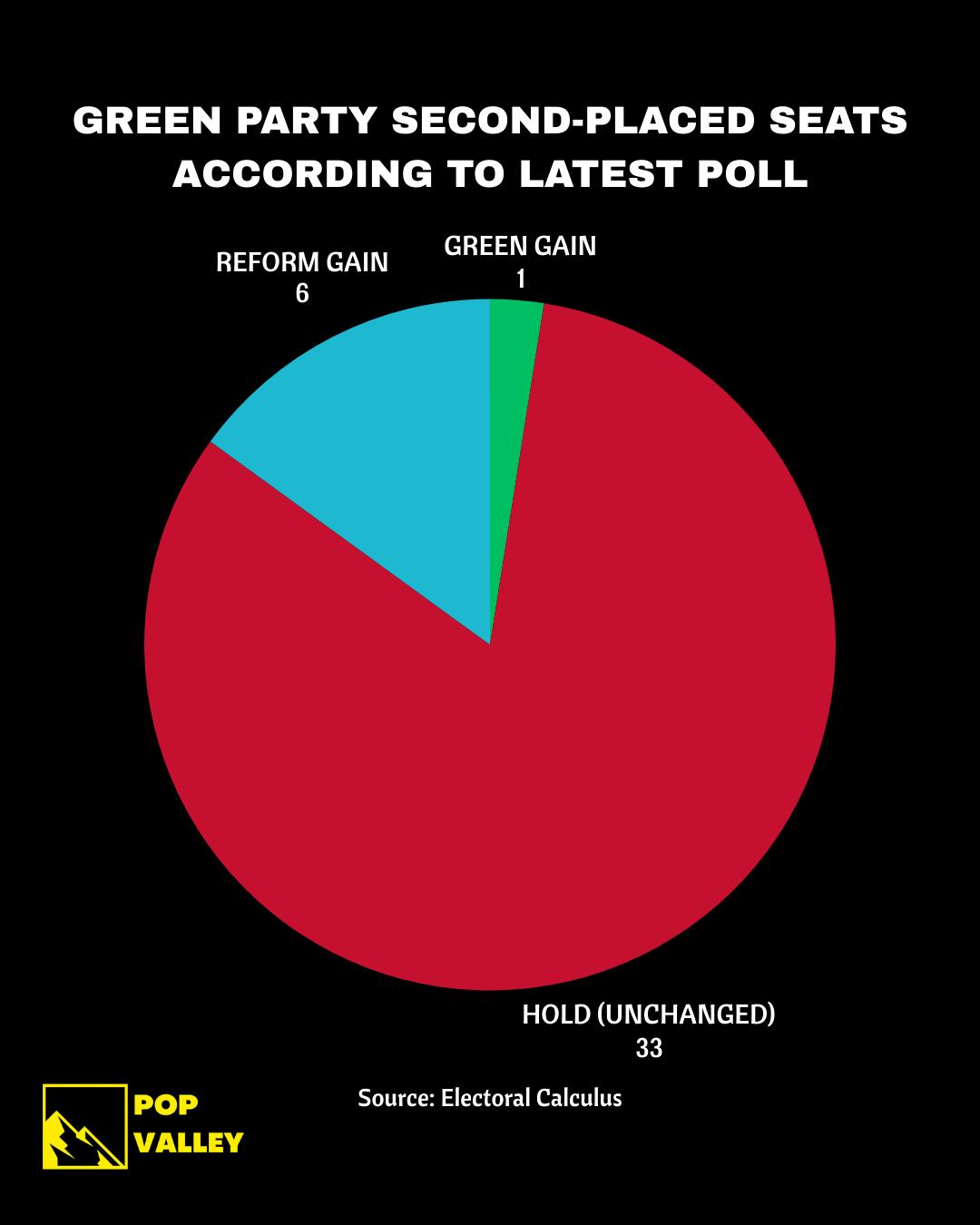
Reform UK’s projected gains in six of the seats where the Green Party came second will presumably have Zack Polanski grimacing.
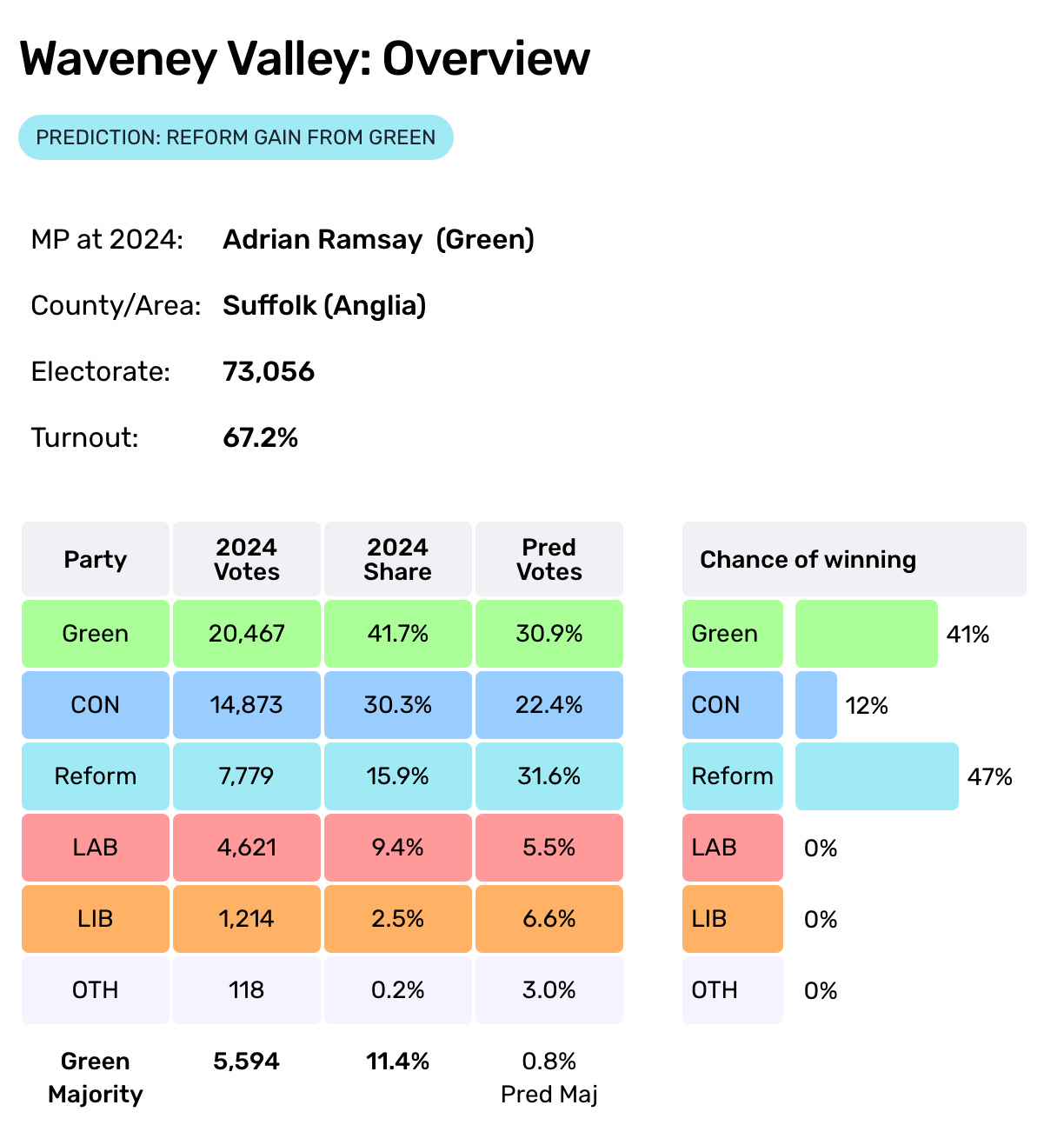
They’ve also got to focus on keeping a firm hold of their current seats—three out of four of which are predicted to be safe—but, the most interesting piece of data from the recent poll is that Adrian Ramsay, former co-leader of the Green Party and main rival to Polanski in this year’s leadership race, is predicted to be the latest to fall victim to the Reform party’s surge.
In an LBC interview during the leadership race, Ramsay repeatedly refused to say whether or not he “liked” Zack Polanski as a person.
The Green Party leader has a lot to work with, though.
In the 2024 election, 1.8 million people voted Green—now, he just needs to turn those votes into seats.
Misrepresentation
Polanski wants electoral reform. He wants the government to implement a version of proportional representation (PR) that will better represent voters and their choices, ditching the first-past-the-post system (FPTP) we currently have, a voting method which Oliver Eagleton calls “antidemocratic”.
“The UK's antidemocratic first-past-the-post voting system makes it extremely difficult for progressive forces to make inroads into Westminster, where power is hyper-centralised.”
- Oliver Eagleton speaking to Pop Valley
Electoral reform (changing the voting system) will also undoubtedly win the Greens more seats.
The 2024 General Election saw the most disproportionate results in British political history, i.e. the number of votes cast didn’t accurately reflect the number of seats won; the Liberal Democrats for example, just over 3.5m votes and 72 seats in the house, but Reform UK, on the other hand, received over 4m votes and have just 5 seats to show for it.
The Greens received 6.4% of the vote share, yet only represent 0.6% of the seats.
With that in mind, I asked Oliver to what extent is Polanski reliant on electoral reform to actually get anywhere:
“There is now a window of opportunity for parties like the Greens to accelerate its [two-party system] collapse and replacement with some kind of proportional representation. This should be a top priority. Among its various benefits, electoral reform would finally rid us of the curse of Labourism -- whereby many on the left, from MPs to trade unionists, remain shackled to the Labour Party and unable to assert themselves as independent agents.”
- Oliver Eagleton speaking to Pop Valley
In his interview with Channel 4, Polanski made it clear he’s more than happy to work with other left-wing parties, stating “it would be wild to do anything other than welcome that”, and that the left is “stronger when we work together.”
Your Party - friend or foe?
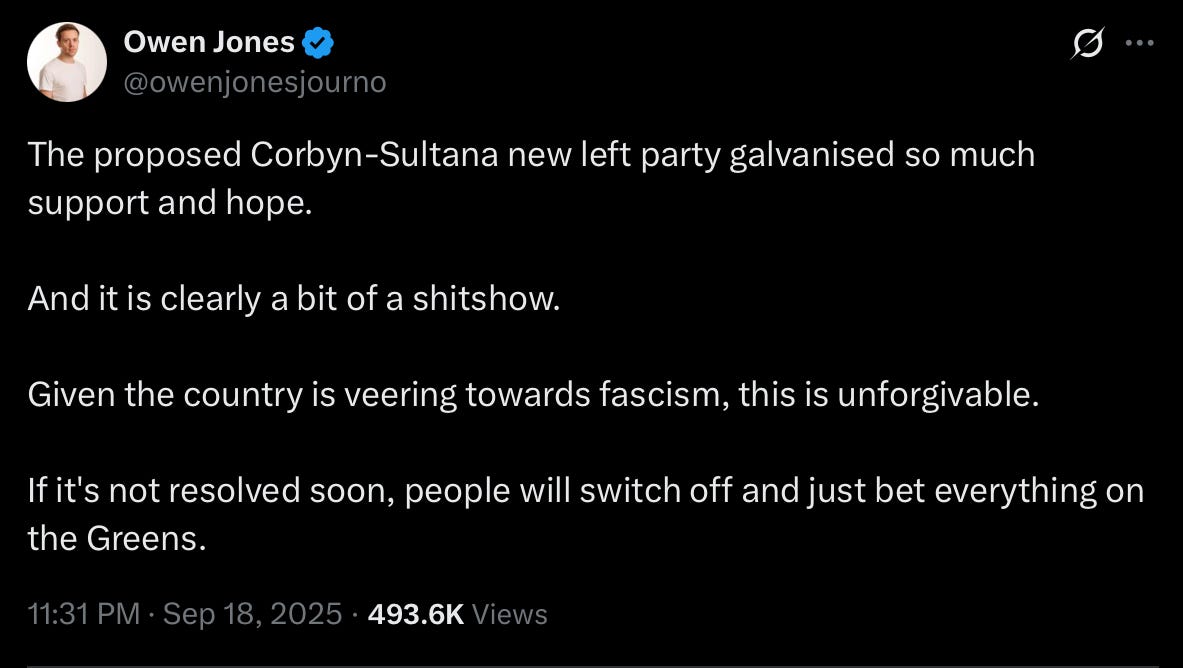
While Polanski may be open to collaboration with other left-wing forces, his biggest potential ally is seemingly already in the pits - struggling to hold itself together, let alone build partnerships with others.
“Your Party”—launched in July—has had a turbulent initial few months, having been beset by the basics from its inception.
Controversially announced on X by a seemingly overly-eager Zarah Sultana MP, the party was introduced into the British political media sphere more like a cryptic and unforthcoming teaser trailer for a Hollywood movie rather than a serious political project.
A Hollywood movie which, despite not even having a proper name, did have 80,000 people on the mailing list within the first five hours.
And it had a cast: former Labour leader Jeremy Corbyn, his independent alliance, and Zarah Sultana, who simultaneously declared her resignation from Labour within the launch statement.
While Corbyn was initially said to be “frustrated” by the unilateral announcement, he did confirm the launch himself a few days later. They said that “Your Party” was an interim name, and would be replaced by a new name as voted for by members, with a formal announcement expected at the planned November party conference.
It felt like a publicity stunt. Or at least, that’s how they tried to make it feel in the days that followed.
The stunt-like gloss faded quickly though, as last week, the newly-formed party found itself in disarray again.
Last Thursday, Your Party supporters received an email offering £55 annual memberships. Sultana said that over 20,000 people signed up, but her co-leader, Corbyn, released a statement encouraging supporters to cancel their direct debits while he sought legal advice on the “unauthorised email”.
Within a few hours, Sultana stated that her treatment had been “appalling” and that she’d been “excluded” from a “sexist boys’ club”. The next day, she announced she was instructing legal advisors of her own in the form of defamation lawyers, to hold accountable those who have made “baseless character attacks”.
“Whatever they are going to set up doesn’t exist yet. I don’t think we have time to wait around.”
- Zack Polanski speaking to Sky News’ Trevor Phillips
For Polanski’s Greens, the turmoil inside “Your Party” is both a gift and a curse.
The implosion might make disillusioned Corbyn-Sultana supporters want to seek a more stable home, accelerating the Green Party’s growth. But, on the other hand, the infighting could quite simply fracture the left to the point where proportional representation could be the only remedy.
And a Starmer government won’t be considering electoral reform any time soon.
The way forward
Polanski’s best bet is to consolidate the left, but as it stands, “Your Party” is complicating things.
“As long as the Greens and Your Party agree to work together, it won’t be a problem to have two national parties of the left. It may even be a benefit, because they can represent different parts of the progressive coalition.”
- Oliver Eagleton speaking to Pop Valley
Whilst he doesn’t have any big names on his books such as Corbyn or Sultana, Polanski does have a strategic plan and vision, which is a lot more than “Your Party” have at the moment.
He isn’t getting the same sort of media coverage as Farage and Reform UK, and he doesn’t have the financial power or reputation of the big parties, but the latter will undoubtedly work in his favour.
The way forward is clear: keep the momentum.
His online presence cannot be underestimated. In a political environment where trust in mainstream media is arguably at an all-time low, engaging with people through crisp, sharp content is definitely the game to play.
The Green Party leader is doing just that, not least through endorsement from progressive, high-engagement accounts such as JOE Media Group, and through his own podcast, Bold Politics with Zack Polanski.
If he can keep the momentum and change the narrative of immigration, he can achieve something no other Green leader has ever realistically envisioned: making the party feel relevant beyond their environmental standpoint, taking them from a small party to a big one, and filling the void in British left-wing politics.
Thanks for reading.
If you enjoyed it and think you could contribute something similar (or better), we’d love to get you involved. Drop us a message or an email to find out how you could write for Pop Valley.
popvalleypress@gmail.com